
Building the future of India’s road infrastructure
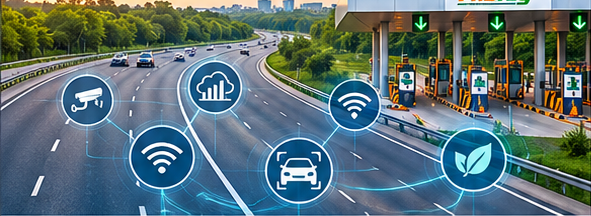
India’s highway monetisation programme has positioned Infrastructure Investment Trusts (InvITs) as an important vehicle for recycling infrastructure capital. Their long-term success depends on revenue integrity, efficient operations, asset longevity and investor confidence. Digital transformation is therefore a strategic business imperative, not merely an IT initiative.
Intelligent asset management
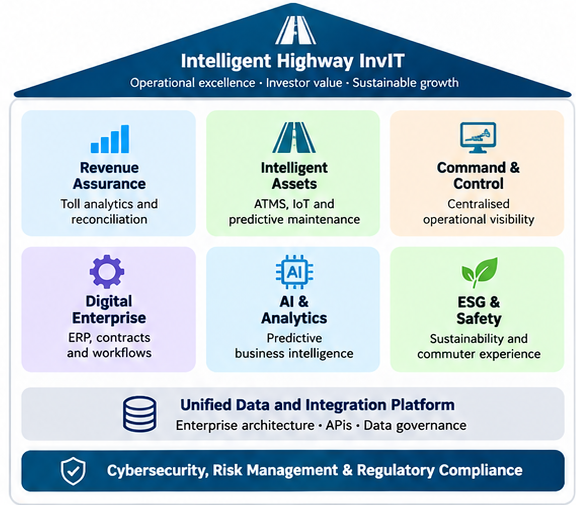
Integrating GIS, IoT, road condition surveys and analytics enables continuous monitoring of pavement, bridges and road furniture. Predictive maintenance can reduce unplanned expenditure and improve asset availability.
Toll revenue assurance
Integrating FASTag transactions, vehicle classification, traffic counts and financial settlements helps identify discrepancies and revenue leakage. Comparing actual traffic and revenue against financial models strengthens commercial oversight. Multi-Lane Free Flow (MLFF) readiness can further support seamless tolling.
Centralised command and control
A unified command centre integrating ATMS, surveillance, incident management and field reporting provides portfolio-wide visibility, enabling coordinated emergency response and operational accountability.
Enterprise digitisation and governance
Integrated ERP, e-office, document management, procurement and contract management across the Trust, Investment Manager and SPVs can strengthen approval controls, audit trails and reporting under applicable SEBI InvIT regulations.
From reactive operations to predictive intelligence
Artificial intelligence and analytics
AI can support traffic forecasting, revenue prediction, pavement deterioration analysis and maintenance prioritisation. Computer vision can complement engineering assessments using dashcam, drone and Network Survey Vehicle data.
Road safety and commuter experience
Intelligent incident detection, traffic advisories, emergency coordination and digital grievance redressal can improve safety and service reliability.
Sustainability and ESG
Digital monitoring of energy, emissions, solar infrastructure and environmental compliance enables measurable sustainability outcomes. Efficient tolling and predictive maintenance can reduce idling and resource consumption.
Cybersecurity and scalability
A secure, interoperable architecture with access controls, data governance, disaster recovery and operational technology security is essential as the portfolio expands.
Conclusion
Digital transformation should be treated as a strategic enabler of revenue optimisation, cost efficiency, governance excellence and sustainable investor returns. The next phase of India’s highway transformation will be defined not only by kilometres developed, but by how intelligently and sustainably those roads are managed.
Author Biplab Santra DGM (IT & Procurement)
More insights
All insights →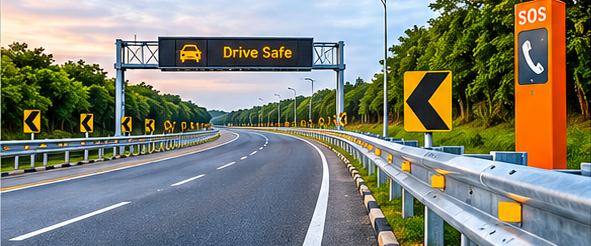 Road Safety
Beyond the Pavement
Why quality road furniture is essential for a successful highway InvIT
Road furniture — signs, markings, delineators, crash barriers and lighting — is the silent infrastructure of safety, and a lifecycle investment that protects commuters and long-term asset value.
Amitav Chakraborty DGM (Maintenance & Safety)